
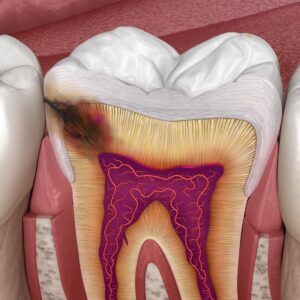
Even though you can likely only see an average of three of them, your teeth actually have five surfaces, including the front, back, two sides, and the biting edge or chewing surface. However, while the three easily visible areas can be properly cleaned with your trusty toothbrush, the sides that touch each other (known as interproximal) can be harder to access, and thereby more prone to cavities and decay. Here’s how to keep them healthy despite this!
What Causes Cavities to Develop?
Cavities, (AKA dental caries) develop because of an acid biproduct created when dangerous oral bacteria dine on left-behind bits of food and dental plaque that accumulate on your teeth. This in turn weakens their enamel, creating small holes or “cavities” that if left untreated can lead to decay and infection.
Why Are Interproximal Cavities So Common?
Because plaque and food particles can be extremely difficult to clear away from between your teeth by brushing alone, every meal and beverage besides water puts them at an increased risk of cavities. Worse yet, because of their hard-to-access location, interproximal cavities can also be very hard to spot without the help of a dentist.
How Can I Prevent Cavities Between My Teeth?
The good news is that you don’t have to simply leave protecting your smile to chance. The American Dental Association recommends flossing daily to remove particles of food and plaque from between the teeth. Best of all, how you do it is up to you! You can choose traditional string floss, interdental brushes, or even a water irrigator depending on your preference.
Additionally, be sure to brush twice a day with a soft-bristled toothbrush and fluoridated toothpaste and visit your dentist every six months for your regular checkups and cleanings. Not only will this provide a closer look at what’s going on between your teeth, but it’s also your biannual opportunity to clear away any tartar that may have accumulated on your them since your last visit!
Is It Possible to Reverse Cavities That Are Already Forming?
A question I get asked a lot is if it’s possible to reverse cavities that have already begun forming. The good news is that yes, they can sometimes be stopped by strengthening the enamel with fluoride. However, once a hole has developed, it will need to be filled before it gets larger, so the sooner you detect the damage, the smaller the restoration you’ll need.
In my practice, I’ve treated patients ranging in age from three to 103, and while every smile is unique what they all have in common is that protecting the spaces between the teeth is just as important as caring for any other surface. In fact, no matter what your age, regular flossing can reduce your risk of interproximal cavities by about 40 percent!
If you’re in the Oklahoma City area and looking for a dentist to ensure every surface of your teeth are clean, healthy, and strong, feel free to schedule an appointment with me and I’ll be happy to help!
About. Dr. Mitchell
Dr. Bradley Mitchell received his undergraduate degree at Oklahoma State University and his dental degree at the University of Oklahoma College of Dentistry. Today, he continues to expand his dental skills and knowledge through regular continuing education courses from Spear Education and the Kois Center. He is also a proud, active member of the American Dental Association, the Oklahoma Dental Association, the American Academy of Cosmetic Dentistry, and the Academy of General Dentistry. To schedule a consultation for restorative dentistry, visit our website or call us today at 405-755-2670.